


Home for Who?
- Feb 1
- 5 min read
Updated: Feb 2
Sometimes, I think that the pride and the belief of an educated person who is aware of social discrimination thinking that they treat people better than others do, when it comes to questions of caste, class and gender is somehow worse than people who are completely uneducated or uninformed about the topic. There are several reasons for this:
People convince themselves that a certain amount of education and awareness automatically makes them better at confronting sensitive issues which is possible but isn't always the case.
Most of this behavior seems performative like one is in a race to prove themselves morally fairer than the rest with people taking in account how much ‘good’ they have done, quantifying it, and in the process end up ignoring the root matter in question. People feel satisfaction of doing the bare minimum.
When people close to us act ignorant, it's even more hurtful and makes us have important realizations about them as well as ourselves.
Growing up, I had quite a few of them within and around my family.
Occasions like poojas had my house packed with relatives occupying every room to accommodate them all. There was a noticeable pattern of who sat in which room. In the living room, sat the bhatji of course, with one man always sitting besides to tend to his needs. Though he wasn't the one conducting the pooja, whenever the bhatji asked for items, the man, without leaving his chair, called for someone and conveyed the message to them for the task to be fulfilled. Most of the time, it was either a woman taking laps between the kitchen and the living room or kids as they always said “ Why do you trouble yourself? Kids are light on their feet. They'll get the job done.” The man acting as a mediator claiming to know all about the rituals and religion pretending that he was actually doing something important hovering over the bhatji always made me chuckle. His seat in every pooja is fixed.

Gendered Study of the House during Family Occasions (Circulation and Frequently occupied spaces)
More often than not, the living room was mostly occupied by men chatting over family affairs or property disputes. This ultimately led to new guests analyzing the sitting arrangement and automatically parting themselves with more men filling the living room and women disappearing into one of the two bedrooms. One interesting observation was though this arrangement was the most obvious example of men involuntarily claiming space with their conversations considered more important and rather boring for the women, proved by nobody ever by the way, the women had, over the years, created a space of comfort in the bedroom. The living room was always stuffy as the fan couldn't be on during conducting rituals and men in their eternal dress code of shirt and trousers sat there without carrying out any activities. While the women draped in six yards of cloth and heavy jewelry needed air and hence felt more comfortable in the bedroom. Though they always complained about how itchy it would get and would be better to wear a simple Punjabi suit next time, continued to ignore their own advice in fear of seeming like the odd one out when there were no restrictions of dressing in our family or at least at our place.
Another reason why women preferred the bedroom was taking short breaks from sweating profusely in the kitchen helping each other out to cook/serve snacks making sure no guest is left unsatisfied. The kitchen was always packed with panic and prying hands looking to secure some work to do when in actuality, no one wanted to work but did it as a sense of duty, the proof being the arguments made after an event ended, of how more or less one contributed in the kitchen. Voluntarily or otherwise, their labor is the reason why these events were possible. The men helped with chores too, but they weren't as consistent and upon asking them why both the genders don't spend much time together, their answers would often be, “They feel more comfortable with other women”, “Let them have some peace as they are always working”, “ Even after calling them to get involved multiple times, they don't respond. Must be because they are shy”. At first, these responses feel sympathetic and caring but further makes us think about why the men never questioned the other way as to “why do women feel discomfort with us?”, “ Why aren't we working as much as they are on occasions like these?”, “Why do women still feel shy sitting in the same space after being a part of the family for so many years?” The same questions were asked to women and they responded with “It's our house and our duty”, “Who would do it if we don't?”, “I've done it for so many years now”. Regarding space it was more of “Let the men talk within themselves”, “What business is it of ours?”
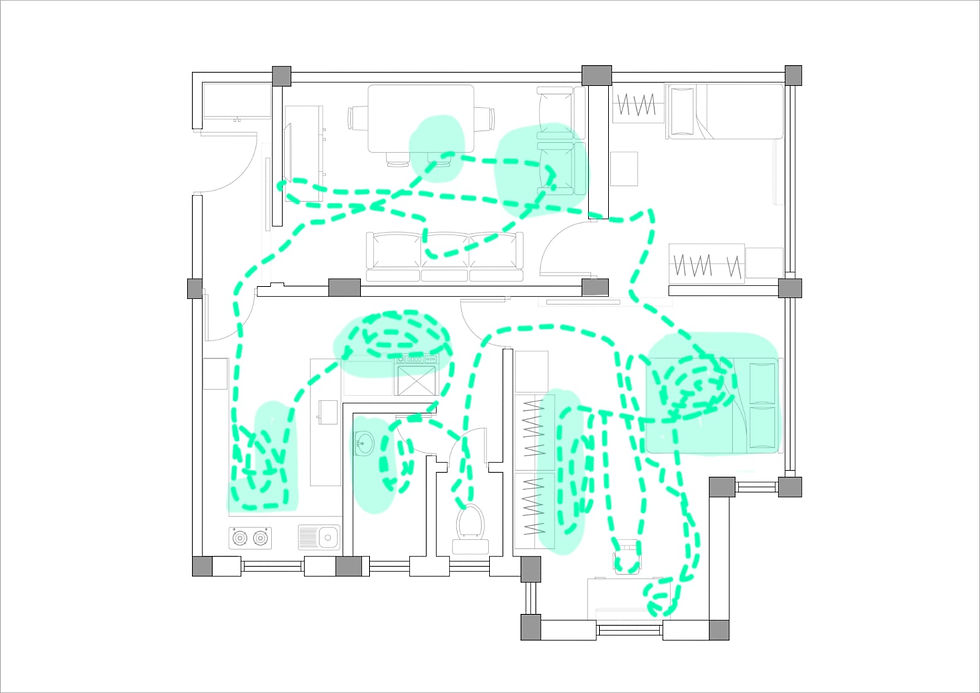
My grandmothers frequented these replies. This is reflected in our daily life too, as they loiter around in the kitchen and around the house as much as possible from morning to night even in absence of work. There is a constant worry of tasks going awry if they don't supervise the space. This has continued to be cyclical as my mother started showing the same behavioral patterns. Offers of help from my father are seldom accepted and usually a result of him firmly telling them to go and rest and isn't considered as a fixed schedule. Similarly ,my brother is sighted inconsistently doing chores around the house compared to me.
These patterns show how space is navigated within the framework of the patriarchal system. Spatial behavior is developed over years of practices, habits and mindset. How each space itself becomes a character providing safety, comfort, ease, etc. Hesitation of action and communication between genders about past practices and customs breeds stigma of certain spaces and company keeping the patriarchal cycle alive further making spaces more alienating to different genders. The belief of sacrificial duty and what is considered as vital conversation also affects the occupancy of space directly.
Two very important members who keep individual schedules from going haywire are the house help. The cleaning lady is endearingly called ‘aaji’ and Kalpana tai who prepares all meals of the day. When they had newly joined, Kalpana tai was hesitant to leave the kitchen even when necessary and just called out to my grandmother. Over time, she got comfortable to roam around and talk more freely but until now, even upon insistence, doesn't take a chair when having tea and stacks, sitting on the floor in the kitchen. She spends her maximum time in the kitchen, bathroom and passage area. Aaji however is harder to convince and works on the clock quickly cleaning around the house, has a snack for about ten minutes and returns back to work around the service area with no further breaks being almost impossible to scope when she left the house through the back passage.
It's indeed significant how financial class plays a huge role in claiming space. The space we see as most comfortable, our home, is an indicator of hierarchies, contrast of living conditions and social treatment between people of different financial classes. It's important to question the social systems and educate ourselves on how we can make interactions more equal and inclusive.

Comments